
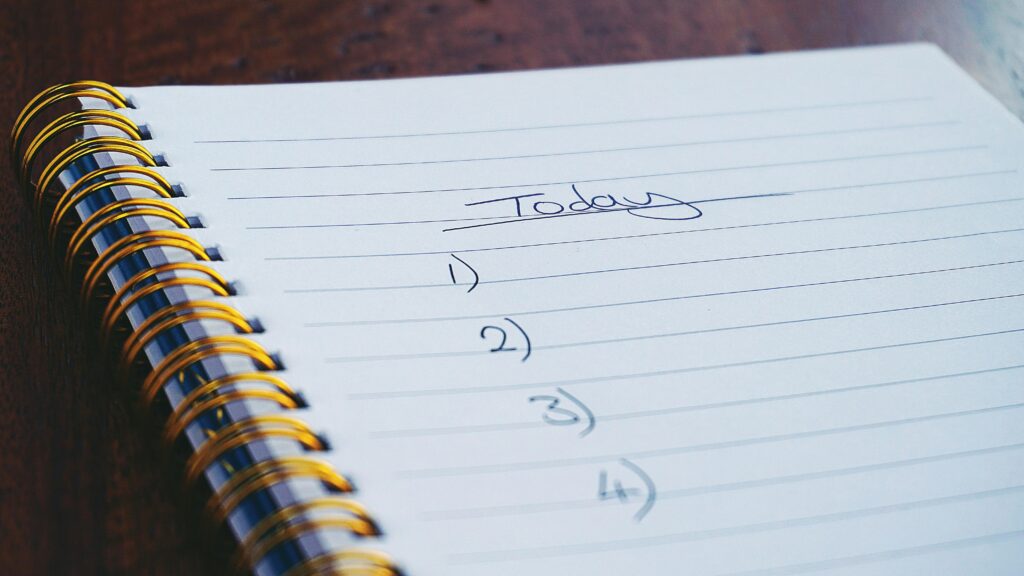
Many people begin their day with a to-do list. It feels like the responsible thing to do. Write down tasks, check them off one by one, and productivity should follow.
But for many professionals, the opposite happens.
They work all day, complete several tasks, and still end the day with the same frustrating feeling: “I’m behind.”
This experience is increasingly common in modern work environments.
Recent workplace studies show that stress and overwhelm have become defining challenges for employees. Research indicates that more than four out of five workers report experiencing workplace stress, which strongly affects productivity, motivation, and overall well-being.
Another large workplace report found that nearly half of employees experience daily work stress, which contributes to burnout and lower motivation.
One reason this happens is that modern work produces a constant stream of tasks. Surveys of knowledge workers show that employees regularly accumulate additional responsibilities each year, often without removing existing ones. As workloads expand, workers increasingly feel overwhelmed and unable to keep up.
This environment makes traditional productivity tools, like long to-do lists, less effective than they appear.
Psychology research explains why. Our brains naturally hold onto unfinished tasks more strongly than completed ones, a phenomenon known as the Zeigarnik effect. When tasks remain unfinished, they continue to occupy mental space and create psychological tension.
In other words, even when you complete several tasks, your brain is still focusing on everything that remains undone.
To-do lists can unintentionally amplify this effect. When dozens of tasks are written down together, they create a visual reminder of how much work is left, which can reinforce the feeling that progress is never enough.
At the same time, the brain rewards small task completion with a dopamine response, making it satisfying to check items off a list, even if those tasks are not the ones that matter most.
The result is a productivity paradox: you can be busy all day while still feeling like you haven’t moved the most important work forward.
Understanding this dynamic is the first step toward a more effective approach to productivity, one that focuses less on completing endless tasks and more on choosing the work that actually matters.
Why To Do Lists Create the Feeling of Being Behind

To do lists treat all tasks as equal.
Answering an email and winning a key customer appear on the same list, even though their impact is wildly different. When everything looks equally important, your brain defaults to what is easiest and fastest to complete.
This leads to a subtle trap.
You feel productive because you are busy, but progress on what truly matters slows down. Important work gets postponed while small tasks multiply. By the end of the day, the list may be shorter, but the most meaningful outcome often remains untouched.
Over time, this creates the constant feeling of being behind.
The Dopamine Trap of Checking Boxes

To do lists are psychologically attractive for a reason.
Every time you check off a task, your brain receives a small dopamine reward. This creates a game like loop where completing tasks feels good, regardless of whether those tasks actually move anything forward.
The problem is not the list itself. The problem is what it trains you to value.
Instead of asking what matters most, you start asking what can be finished fastest. Productivity becomes about completion, not contribution.
Efficiency Is Not the Goal. Effectiveness Is

We have been taught that feeling tired after work means we worked hard.
But exhaustion is not a success metric.
Finishing many tasks is not the same as making meaningful progress. Being efficient at the wrong things still leads nowhere.
The real goal of productive work is effectiveness.
Effectiveness means moving the one thing that actually changes outcomes.
What High Performers Do Instead

Ali Abdaal describes this shift clearly in his work on feel good productivity. Sustainable productivity is not built on pressure and discipline alone. It is built on clarity, positive emotion, and choosing work that matters.
Instead of managing endless lists, high performers prioritize outcomes.
They ask a different question at the start of the day.
What is the one thing I want to move today?
Not five things. Not ten things. One.
This approach is closely aligned with the principles of Essentialism, which focuses on the disciplined pursuit of less. When you choose the vital few, everything else becomes optional.
A Simple Example
Imagine you are close to winning an important customer.
If closing that customer would define the success of the entire month, then the most effective use of your day is obvious. You work on the presentation, the proposal, or the conversation that moves that deal forward.
In that situation, clearing emails or organizing files does not matter.
You deliberately remove other tasks from your list, because winning that customer outweighs everything else.
That is effectiveness.
Why Doing Less Reduces Stress and Increases Happiness

When you focus on one meaningful priority, your stress level drops.
Your brain no longer juggles dozens of open loops. Your attention becomes stable. You know what success looks like for the day.
This clarity changes how work feels.
You are more present. You experience progress earlier. You finish the day with a sense of completion instead of depletion.
Feeling energized after work is not a sign that you did too little. It is often a sign that you worked on the right thing.
Breaks Are Not Laziness. They Are Part of Effective Work.
When you create space by doing less, a new temptation appears.
Filling the freed time with more tasks.
Resist that impulse.
Research consistently shows that taking breaks improves focus, creativity, and overall productivity. Short pauses allow the brain to recover and integrate work instead of running in constant overdrive.
If you finish your priority early, taking a break is not a failure. It is part of a sustainable system.
A Better Daily Question
Instead of starting your day with a long to do list, try this.
Ask yourself:
What is the one thing that would make today feel like progress once it is over?
Write that down.
Work on it first.
Let everything else be secondary.
You do not need to earn rest by exhaustion. You do not need to click boxes to feel good about your day.
Progress feels good on its own.
How This Fits Into the Flowdayz Approach
This shift away from to do lists is a core part of the Flowdayz philosophy.
Designing a better workday is not about packing more into it. It is about choosing with intention, working with clarity, and ending the day with energy left.
The Flowdayz Workday Guide helps you apply this thinking across your entire day. From how you start, to how you choose priorities, to how you end work without mental spillover.
Work does not need to leave you drained.
It can leave you clear, calm, and energized.