14 August 2026 · 10 min read · Updated 2 September 2026
Flowdayz vs Finch: an honest comparison
A side-by-side comparison of Finch and Flowdayz. How each works, what each costs, where your effort ends up in each, and where Finch is the better choice.
Finch and Flowdayz get compared often enough that a direct answer is useful. This is that comparison, written by the people who build Flowdayz, which is worth knowing before you weigh anything below.
The two apps are less similar than the category suggests. They disagree about where motivation comes from, and about where your effort should end up, and almost every other difference follows from those two.
At a glance
| Finch | Flowdayz | |
|---|---|---|
| Core mechanism | Care for a virtual bird that grows as you act | One planned action a day, sized to your schedule |
| Where motivation comes from | Outside you, the pet depends on you | Inside you, the app assumes reasons and resizes the ask |
| On a day you miss | The streak returns to zero | Uncounted; the cumulative total is unchanged |
| Gamification | Currency, outfits, collectables | None |
| What your effort builds | A bird, and its wardrobe | Your actual week |
| Time in app | Designed to be visited often | Designed to be closed |
| Comparison to other users | Community features | None |
| Where it runs | iPhone and Android | iPhone and Android |
| Free tier | Yes, the core is usable free | No; seven day trial, then paid |
| Price | Roughly $35 to $70 a year, varying by platform and region | $49 a year, or $8 monthly |
How Finch works
Finch is built on a single idea, executed carefully: doing something for yourself is difficult in a way that doing something for someone else is not.
You look after a small bird. It grows as you complete actions: breathing exercises, reflections, journaling prompts, check-ins. Completing them earns currency you spend on outfits and items. The tone is warm, the actions are small, the onboarding is patient.
The mechanism is not a gimmick. On a morning when you have nothing available for yourself, you may still have something available for a creature that is waiting. That is a real route to action, and Finch's rating reflects how well it works for the people it suits.
How Flowdayz works
Flowdayz is a feel good app. You learn what actually makes you feel good and what gets you into flow, usually the smallest things, and the app helps you get there every day. It starts from the opposite assumption: that you already have reasons, and the problem is that your plans are calibrated to a version of your day that does not exist.
You answer a short set of questions once. It generates a weekly routine of daily anchors and larger weekly blocks, placed around your actual schedule. Then it shows one action at a time and gets out of the way. There is no pet, no currency, no collection, and no comparison to anyone else. Every number shown is you against your own previous week.
When a category keeps getting missed, Flowdayz does not increase pressure. It reduces the size of the ask, and says that it has.
Where the effort ends up
Start here, because it is the difference that outlasts every feature on the list.
Both apps ask you for the same thing: a small effort, most days. What separates them is where that effort accumulates.
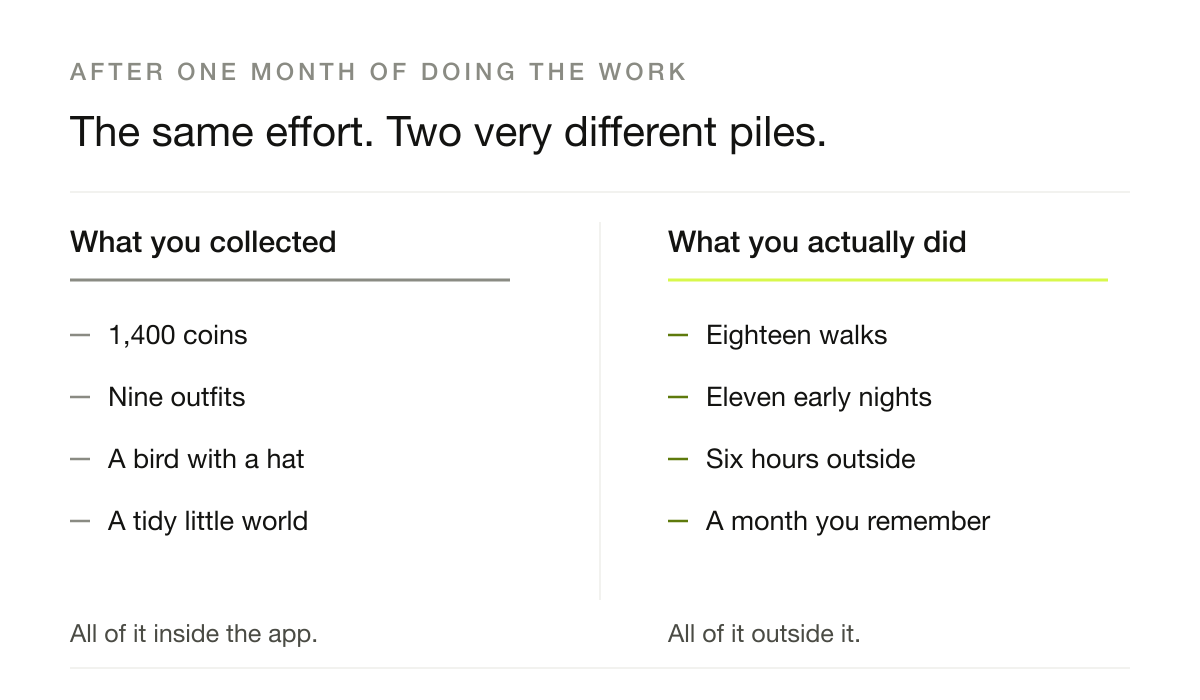
In Finch, completing an action earns currency, and the currency buys outfits and items for the bird. That loop is why the app works. It gives the effort somewhere satisfying to land on days when your own life is not being satisfying. It is a genuinely clever piece of design and it is not cynical.
But follow it to the end of a month. You have a bird with a hat and a tidy little world, and both of them live inside an app you will one day stop opening.
Flowdayz has nowhere to put the effort except your actual week. There is nothing to decorate, nothing to unlock, nothing to grow but the thing you were trying to grow in the first place. The reward for going on the walk is that you went on the walk.
That is a harder sell and a plainer one. It also means that when you leave, you take everything with you, because none of it was ever stored in the app.
What happens on a day you miss
The second difference is mechanical rather than emotional, and it is worth being concrete about.
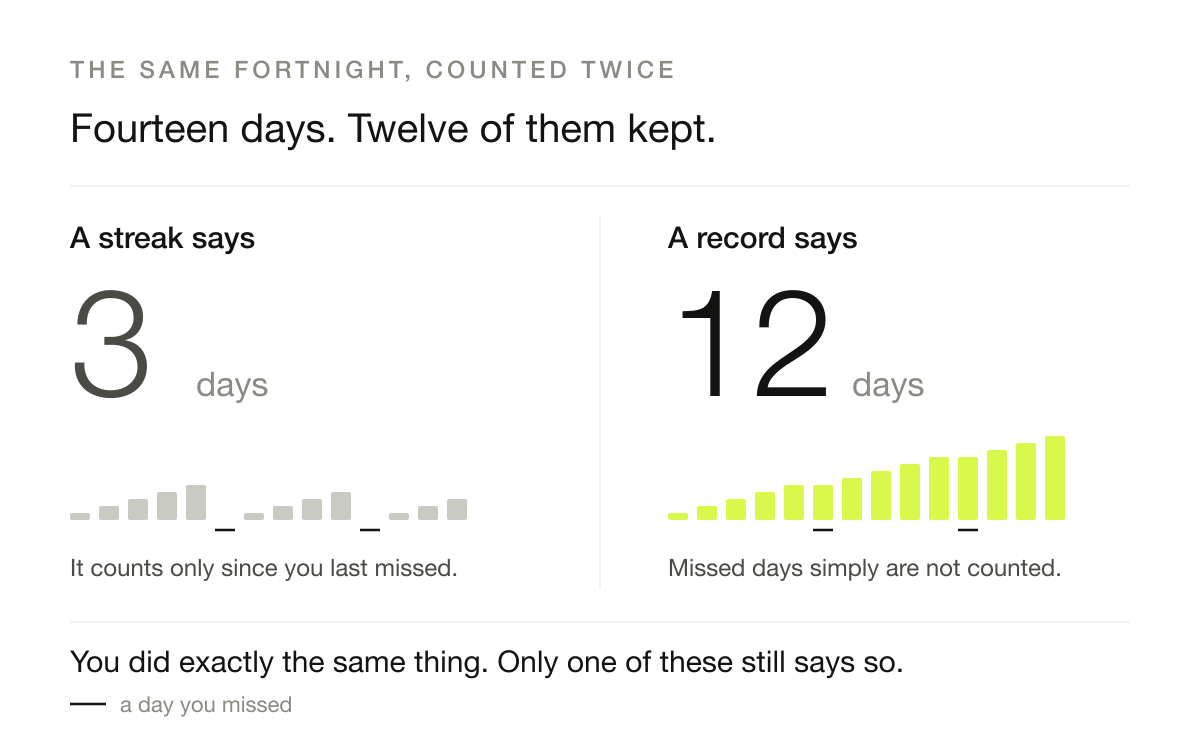
Both columns above describe an identical fortnight: twelve days kept, two days missed. The streak reports it as three. The cumulative record reports it as twelve.
Neither number is dishonest. They measure different things, consecutiveness against volume, and consecutiveness is genuinely motivating for a lot of people. The question is what happens to that motivation on the day the run breaks, which for most people is also a day when other things were already going wrong. The cost of a broken streak is rarely that people stop wanting the habit, it is the fortnight that actually happened becoming invisible.
Flowdayz stores the cumulative version, deliberately. Nothing resets, nothing turns red, and a missed day is never subtracted from what came before.
How much of your attention each one wants
This difference does not appear on any feature list, and for a lot of people it is the one that actually decides it.
Finch is designed to be visited. The bird, the currency, the outfits, the collection. Those are engagement mechanics, and they work by giving you reasons to open the app on days you had no other reason to. That is not a criticism. It is the design, and it is executed unusually well.
Flowdayz is designed to be left. It shows the one thing for today and then has nothing further to offer you. No shop, no collection, no feed, nothing to check. Time spent inside Flowdayz is not a number anyone here is trying to increase, which is a strange thing for a subscription product to say and is nonetheless the position.
So the real question underneath this comparison is not which app is better. It is whether you want software that earns its place by being present, or software that earns it by getting out of the way.
Both are legitimate. But if your phone already asks for more of your attention than you would like, then adding something engineered to ask for more of it is a decision worth making on purpose rather than by default.
Where Finch is the better choice
Three situations, and they are not concessions before a pivot. If you recognise yourself here, Finch is likely to serve you better and switching would cost you something.
When external motivation is the missing piece. If you know exactly what to do and cannot get started, a creature that depends on you supplies a reason from outside yourself. Flowdayz does not supply one, because it is designed for people who have their own.
When you enjoy the collecting. The currency, outfits and rewards are a genuine pleasure for many people, and that is not a weakness. Flowdayz has none of it and would simply be duller.
When you want the app to feel warm. Finch is affectionate. Flowdayz is deliberately not. It is spare and gets out of the way. Wanting to be looked after by your software is a legitimate preference, and only one of these two apps caters to it.
Finch is also the more established product. Millions of users and a 4.9 average across more than a million ratings is real evidence that the approach works, and it should count in the decision.
Where Flowdayz is the better choice
The pattern is consistent: Flowdayz fits people for whom the gamified layer is not a help but an additional demand.
If a missed day currently produces a small spike of dread, the mechanism causing that is loss aversion, and removing it removes the dread. If you have abandoned apps not because they failed but because keeping up with them became its own task, that is the specific failure Flowdayz is designed around.
It also fits people who have decided, deliberately, that their phone gets less of them rather than more. One action, then nothing. And nothing is the feature.
What Flowdayz does not have
Stated plainly, because these are real and you should weigh them.
- No free tier. Seven days, then $49 a year. Finch's core is genuinely usable without paying, and if a permanent free option matters to you, that is a real point in its favour.
- No community. No shared goals, no friends, no groups. Plenty of people find that support valuable, and it is absent here by design.
- Less content to explore. Finch's library of exercises, audio and journaling prompts is considerably deeper. Flowdayz plans actions rather than supplying a library to browse.
- Nothing to collect. No currency, no outfits, no unlocks. If those are the part that keeps you coming back, removing them removes the thing that was working.
Price
Finch's pricing is genuinely difficult to state as a single figure, and that is itself among the most common complaints about it. Reported annual prices range from roughly thirty five to seventy dollars depending on platform, region and promotion, and iOS and Android users have not paid the same price for the same product.
Flowdayz is one price in one currency: $49 a year, which is about $4 a month. Or $8 monthly if you would rather not commit to a year. There is a seven day trial first, and the renewal date and amount are both shown before you confirm.
At $49 a year, that lands inside Finch Plus's own reported range rather than above it. Worth stating plainly, because the assumption usually runs the other way. The calmer, more considered product is expected to charge a premium for the privilege. This one does not, and price is meant to be the least interesting part of the decision.
What it does not include is a free tier, and for some people that settles it in Finch's favour on its own.
Decide it in twenty seconds
The table above is the whole picture, which also makes it a lot to weigh. This asks the only question that actually settles it, which of these do you care about, and answers accordingly.
Which one fits you
Tick everything that genuinely matters to you. Nothing is sent anywhere, and the answer moves as you go.
Pick a few above and this will tell you which one to try, including the times that is not Flowdayz.
Three questions that decide it
- When you miss a day, is your first feeling guilt? If yes, an app built on loss aversion will amplify that, whatever its tone.
- Do you need a reason from outside yourself, or do you have your own? Finch supplies one. Flowdayz assumes one.
- Do you want more app, or less? Finch is generous and full of things to do, and rewards you for coming back. Flowdayz shows one action and disappears. If you are trying to spend less time on your phone rather than more, that is not a small distinction.
If the honest answers point to Finch, use Finch. A comparison that concluded otherwise every time would not be worth reading, and the two products are not competing for the same person as often as the category implies.
Questions people actually ask
- Is Finch worth it?
- For most people who try it, yes. It holds a 4.9 average across more than a million ratings, and its central mechanism is sound. Caring for something outside yourself is a well-established route to acting on your own behalf. It suits people who know what to do but struggle to begin. It suits people less well when capacity drops, because the pet keeps asking at the same volume regardless.
- What is the best Finch alternative if I want something less gamified?
- Judge candidates on three specifics rather than on how calm the design looks. Does a counter reset when you miss a day. Is there an in-app currency or collection. Is there a character whose state depends on your behaviour. An app can look minimal and still run entirely on loss aversion. Flowdayz was built to avoid all three, but the checklist matters more than any single recommendation.
- Is there a habit app that does not use streaks?
- A few, though fewer than the marketing implies. Most minimalist habit trackers still run on streaks and loss aversion underneath. The reliable test is what the app does on the day you miss. If a number resets, a flame goes out, or anything turns red, it is using loss aversion whatever the design language suggests.
- Does Finch have a free version?
- Yes. Finch's core is usable without paying, and Finch Plus is the paid tier that adds more of the content and customisation. Flowdayz has no equivalent free tier. It runs a seven day trial and is then $49 a year, which is about $4 a month. If a permanent free option matters to you, that is a real point in Finch's favour.
- Why do people say Finch starts to feel like a chore?
- Because the pet creates an ongoing obligation, and obligations accumulate. In a month with room in it, that obligation reads as a helpful nudge. In a month without room, it becomes another thing waiting on you. The mechanism has not changed; the person's capacity has, and the app has no way of detecting that.
Keep reading
Flowdayz vs Habitica: an honest comparison
A side-by-side comparison of Habitica and Flowdayz. What each costs, what a missed day actually takes from you, and the four things Habitica does better.
Read itFlowdayz vs Streaks: an honest comparison
A side-by-side comparison of Streaks and Flowdayz. What each costs, what happens on a day you miss, and the four things Streaks genuinely does better.
Read it
- comparison
- gamification
- streaks
- habits
- honesty
Make every day your best day.
Flowdayz is a feel good app. You learn what actually makes you feel good, usually the smallest things, and get there every day, around the life you already have.