31 August 2026 · 9 min read · Updated 2 September 2026
Flowdayz vs Habitica: an honest comparison
A side-by-side comparison of Habitica and Flowdayz. What each costs, what a missed day actually takes from you, and the four things Habitica does better.
You set it up on a Sunday, and it was the best evening you had spent with a habit app in years.
An avatar. A class. Nine Dailies, each given a difficulty, because the hard ones pay better. By Wednesday you had a level, a pet, and a small pile of gold you had genuinely earned.
Then work happened for four days. When you opened it again, your character was dead.
The obvious reading is that you are not a game person, or that gamification is a gimmick that wears off. Neither is quite right. Habitica is not a gimmick. It is an open source project that has been on the App Store since July 2015, it is free with no habit limit, and plenty of people have used it every day for years.
What happened is arithmetic, and Habitica publishes it.
At a glance
| Habitica | Flowdayz | |
|---|---|---|
| Core mechanism | Unlimited Habits, Dailies and To Do's, scored as a retro role playing game | One planned action a day, sized to your schedule |
| On a day you miss | Your character loses health. At zero health you lose a level, all your gold and a piece of equipment | Uncounted; the cumulative total is unchanged |
| Repeated misses | The Daily turns redder, and a redder Daily costs more damage the next time it is missed | Nothing accumulates against you |
| Social | Parties, where your missed Dailies damage the people questing with you | None; you are never compared to anyone |
| Where it runs | iPhone, Android and the web | iPhone and Android |
| Price | Free, with optional subscriptions from $4.99 a month | $49 a year, or $8 monthly |
How Habitica works
Habitica is made by HabitRPG, Inc. and its code is public, which is why almost everything below can be quoted from the company rather than inferred about it.
You build a character. Your real tasks become three kinds of in-game object, and Habitica's own FAQ describes the split. Habits are things you might do several times a day or on no schedule at all. Dailies repeat on a schedule you set. To Do's happen once.
Completing things pays out gold, experience and equipment. Levels arrive. Pets arrive. You can join a Party and take on a quest with other people, and the quest progresses as the party completes its tasks.
Two of those three task types can cost you health. Negative Habits do, and so do Dailies. In Habitica's own words: "Missing Dailies causes you to lose HP, but the more difficult they are, the better the rewards."
How Flowdayz works
Flowdayz is a feel good app. You learn what actually makes you feel good and what gets you into flow, usually the smallest things, and the app helps you get there every day. It starts from a different assumption: you already know roughly what would help, and the problem is that the plan was calibrated to a week you are not actually having.
You answer a short set of questions once. It builds a routine around your real schedule, shows one action at a time, and then gets out of the way. There is no character, no list of nine to clear, and nothing that keeps score of you.
What happens on a day you miss
Nearly every habit tracker answers this question with a change to a display. A counter goes back to zero. A score dips. A weekly target closes unmet. Whatever the app took, it took from a number on a screen, and there are about four different rules for the day you miss in circulation.
Habitica's answer is different in kind, and its own help page states it without hedging.
If your HP reaches zero, you'll lose one level, that level's stat point, all of your Gold, and a piece of equipment that can be repurchased.
A character starts with 50 health points. So a bad week does not reset a display. It reaches back into things you had already banked and removes them, and what it removes was paid for by days you actually kept.
That is a coherent design position, and Habitica is more honest about it than most of this category manages. Stakes work. A cost you do not want to pay will get some people through a Tuesday that nothing else would.
It has a failure mode, and the failure mode is the reason most people who leave Habitica leave it. The cost of a bad week is rarely that somebody stops wanting the habit. It is the fortnight that actually happened becoming a debt, and the app turning into the part of the day that feels bad.
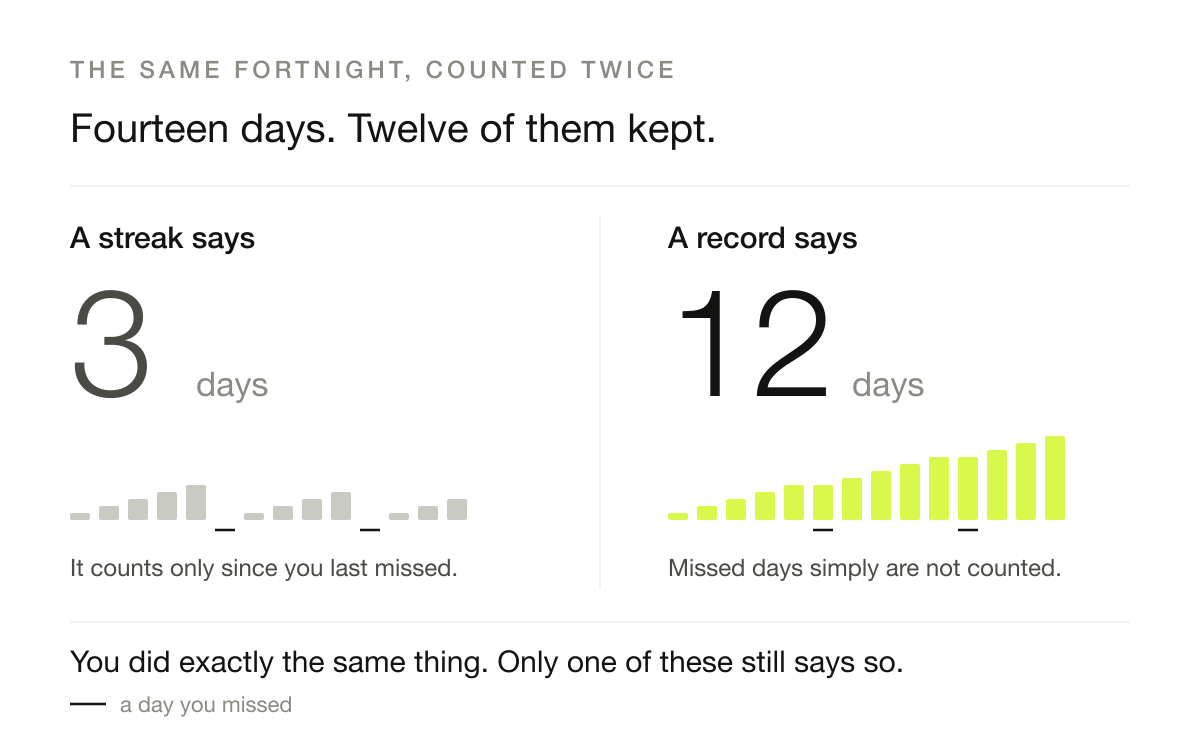
Flowdayz stores the second version, deliberately. A missed day is not counted, and it is never subtracted from what came before it.
The part that compounds
This is the mechanic worth understanding before you commit a month to it.
Habitica's tasks carry a colour, and the colour is the task's value. Its FAQ is specific: Dailies "change color based on how often they are completed, becoming more blue as they're completed or more red if they're missed."
Redness is not decoration. Habitica's guidance on avoiding health loss recommends class skills that "reduce a Daily's redness, lowering damage taken if missed".
So the Daily you keep missing becomes the Daily that costs the most to miss. The charge rises exactly where you are already struggling, which means the bad month is priced higher than the good one. Nothing about that is a comment on your discipline. It is an arithmetic property of the design, and it is doing precisely what it was built to do.
Habitica knows this, which is the most telling thing in its documentation. There is a button in Settings called Pause Damage, described in the FAQ as being for a holiday, a rest, "or for any other reason you might need a break". There is a help page whose title is the question "How do I prevent losing HP?"
You do not build either of those unless the damage is a thing your users need a way out of.
Where Habitica is the better choice
When it is the game that gets it done. Some people genuinely respond to a level, a pet and a party, and shrug off a dead character as a bad run. If that is you, this post is not about you, and there is nothing else in the category built to this depth.
When you want it free. Habitica is free, unlimited, and its own listing says it can be fully enjoyed that way. Flowdayz has no free tier at all. On price this is not close and it would be odd to pretend otherwise.
When you want people beside you. A Party is a small group whose quest progress depends on everyone's tasks, and Habitica's FAQ confirms that you still take damage from a Party member's missed Dailies even while your own damage is paused. That is real accountability with real people in it. Flowdayz has nothing of the kind.
When you want it open. The code is public and the app runs on iPhone, Android and in a browser. Flowdayz is a phone app on iPhone and Android, and that is all it is.
Where Flowdayz is the better choice
If you have been round this loop a few times, downloaded something in January, built a real run, lost a week to work and quietly stopped opening it by February, then the stake is the mechanism. Take the stake away and the loop has nothing to run on.
It also suits people who do not want a task list looking back at them. Flowdayz shows one action, sized to the day you are actually having, and when something keeps getting missed it reduces the size of the ask rather than raising the price of missing it.
Count the days you keep, not the days you missed. Nothing on screen goes down.
What Flowdayz does not have
Stated plainly, because these are real and worth weighing.
- No free version. A subscription, after a seven day trial. Habitica costs nothing.
- No game. No avatar, no levels, no pets, no gear, nothing to collect.
- No community. No parties, no quests, no shared tasks, nobody else in it at all.
- No web or desktop app. Phones only.
- No unlimited task list. One action a day, which is the wrong product if you want a dozen things tracked, though the number itself is worth a second look.
- Not open source.
Price
Habitica is free. Optional subscriptions are $4.99 a month, $14.99 for three months, $29.99 for six months, or $47.99 a year, and they buy cosmetics, a monthly currency and convenience rather than access.
Flowdayz is $49 a year, about $4 a month, or $8 monthly, after a seven day trial. There is no free tier and no upsell after it.
A year of Habitica's most expensive plan costs roughly what Flowdayz costs, and Habitica's free version costs nothing at all. If price decides it, it has already decided.
Decide it in twenty seconds
Which one fits you
Tick everything that genuinely matters to you. Nothing is sent anywhere, and the answer moves as you go.
Pick a few above and this will tell you which one to try, including the times that is not Flowdayz.
Three questions that decide it
Does a real stake move you, or flatten you? Be honest about the answer you have, not the one you would prefer. If the possibility of losing a level is what gets you to the gym, Habitica is built for you and Flowdayz is not.
What do you want to happen on the fourth bad day in a row? Habitica's answer is that it costs more each time. Flowdayz's answer is that nothing happens, and the count picks up whenever you do.
Do you want other people in it? A Party is genuine accountability and some people need it. If the thought of anyone else seeing this makes you want to close the app, start with one action instead.
There is no character to bring back. There is only the next ordinary Tuesday, with one thing on it that fits.
Questions people actually ask
- Is Habitica worth it?
- For a lot of people, yes. It is free with no habit limit, it is open source, it has been on the App Store since July 2015, and it holds around 3,200 US ratings averaging 4.3. If turning your chores into a game is genuinely the thing that gets them done, nothing else in the category does it as thoroughly. The question is not quality. It is whether you want a missed day to cost you something you had already earned.
- What happens in Habitica if you miss a day?
- You take damage. Habitica's own FAQ states that missing Dailies causes you to lose health points, and that if your health reaches zero you will lose one level, that level's stat point, all of your gold, and a piece of equipment that can be repurchased. A character starts with 50 health points. There is a Pause Damage setting for holidays and rest, and like any insurance it has to be switched on before the days you needed it.
- What is the best Habitica alternative if I do not want the game?
- Judge candidates on what the app does on the day you miss rather than on how much game is visible on the surface. Most alternatives still keep a mechanic that charges you something, whether that is a streak returning to zero, a score that decays, or a weekly target that closes on Sunday night. Habitica is unusual in that its charge comes out of progress you had already banked rather than out of a display.
- Is Habitica good for ADHD?
- Habitica's own App Store listing names ADHD among the things people use it for, which is the company describing its users rather than a clinical claim, and nothing here is medical advice. What can be said about the design is that it pairs an immediate reward with a real stake, which some people find helpful, and that it also creates an unlimited task list somebody has to maintain. Test both parts before paying for anything.
- How much does Habitica cost compared to Flowdayz?
- Habitica is free, and its own App Store listing says it can be fully enjoyed that way. Optional subscriptions run $4.99 a month, $14.99 for three months, $29.99 for six months and $47.99 a year, and they buy cosmetic and convenience extras rather than the core product. Flowdayz has no free tier and one price, $49 a year or $8 monthly, after a seven day trial. On price this is not close.
Keep reading
Flowdayz vs Finch: an honest comparison
A side-by-side comparison of Finch and Flowdayz. How each works, what each costs, where your effort ends up in each, and where Finch is the better choice.
Read itFlowdayz vs Streaks: an honest comparison
A side-by-side comparison of Streaks and Flowdayz. What each costs, what happens on a day you miss, and the four things Streaks genuinely does better.
Read it
- comparison
- habitica
- gamification
- habits
- honesty
Make every day your best day.
Flowdayz is a feel good app. You learn what actually makes you feel good, usually the smallest things, and get there every day, around the life you already have.