15 August 2026 · 8 min read · Updated 31 August 2026
The loneliness of working from home is not about friends
You have not lost anyone. You have lost the incidental contact a working day used to include, and the usual advice asks for energy that being lonely takes away.

It is around four in the afternoon. You have done a full day's work, well, and you have spoken to nobody outside of a call that had an agenda.
The strange part is that nothing is wrong. You have people. You are not friendless, or in crisis, or unhappy in any way you could name if somebody asked directly. And yet the day had a quality to it that you would rather it did not have, and it has had that quality for a while now.
That feeling is not a character flaw and it is not ingratitude. It is a fairly precise response to something specific being missing, and it is worth naming what.
What actually went missing
Not friendship. Something duller and more useful.
An office supplied an enormous amount of contact that never registered as socialising. The walk to the station. Two minutes in a queue. Somebody saying something about their weekend on the way past your desk. The person you nodded at daily for three years and never learned the name of.
None of that was closeness. All of it was company, and it arrived whether or not you had the energy to arrange it.
That is the part that got deleted. Working from home did not remove your relationships; it removed the scaffolding that used to sit underneath them and ask nothing of you. And because none of it ever felt important, its absence is hard to point at. You do not miss anyone in particular. The day just has no edges.
The office did not give you friends. It gave you a hundred small contacts you never had to arrange, and that turns out to be a different thing worth having.
There seems to be a threshold, not a slope
Here is the finding that changes what to do about it.
A study in the Journal of Affective Disorders, drawing on 87,317 responses to the 2024 Household Pulse Survey, looked at loneliness against how many days a week people worked remotely. One to two remote days showed no association with loneliness at all. Three to four days showed raised odds of reporting more loneliness, an adjusted odds ratio of 1.16. And five or more days came in lower than that, at 1.09.
Read that last part again, because it is the opposite of what everyone assumes. The most isolating arrangement was not the fully remote week. It was the half-in-half-out one.
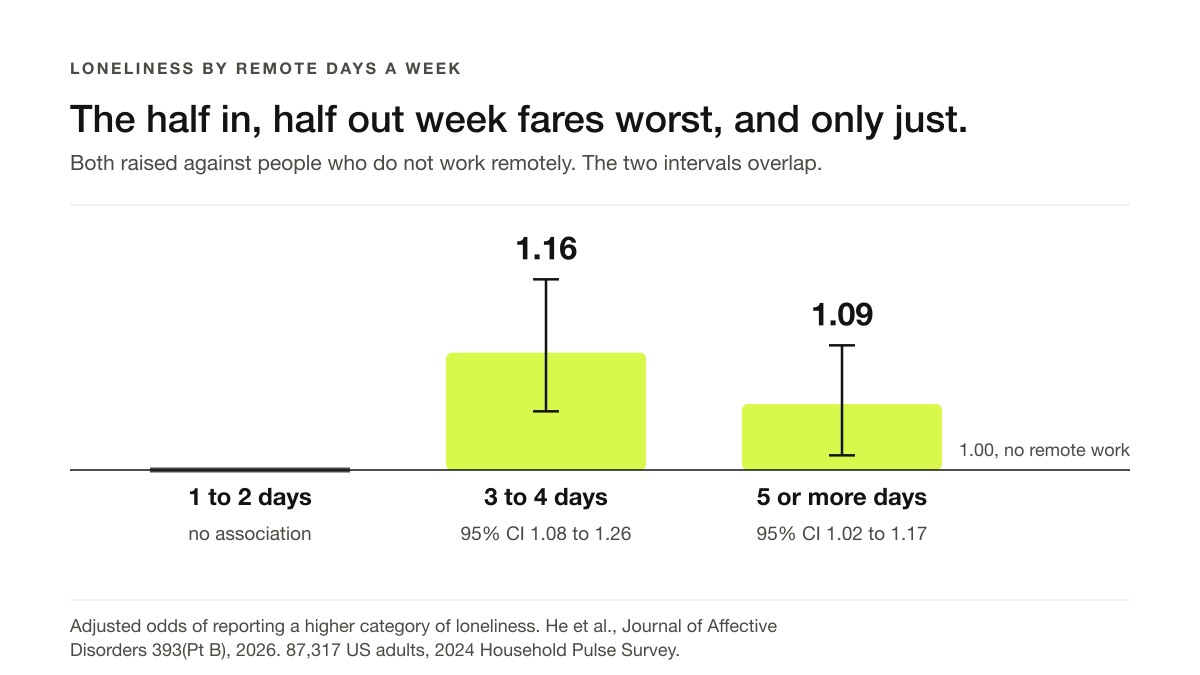
Nobody should over-read a difference that small. The two figures are close, and both are modest. But the shape rules something out. If loneliness simply rose with every remote day, the only fix would be going in more, which for most people is not on offer. It does not rise that way, so the number of days is not really the thing being measured.
A likelier reading is that people who are fully remote know it and build a life around it, while three days in the office feels like enough contact to not need arranging, right up until it is not.
The second study is larger and blunter. Natalia Emanuel, Emma Harrington and Amanda Pallais, publishing in Science in June 2026, followed more than half a million American workers from 2011 to 2024, setting aside the peak pandemic years. Remote workers spent about one additional hour alone each working day than comparable in-person colleagues, and did not make it up afterwards; the evenings did not fill in what the day removed.
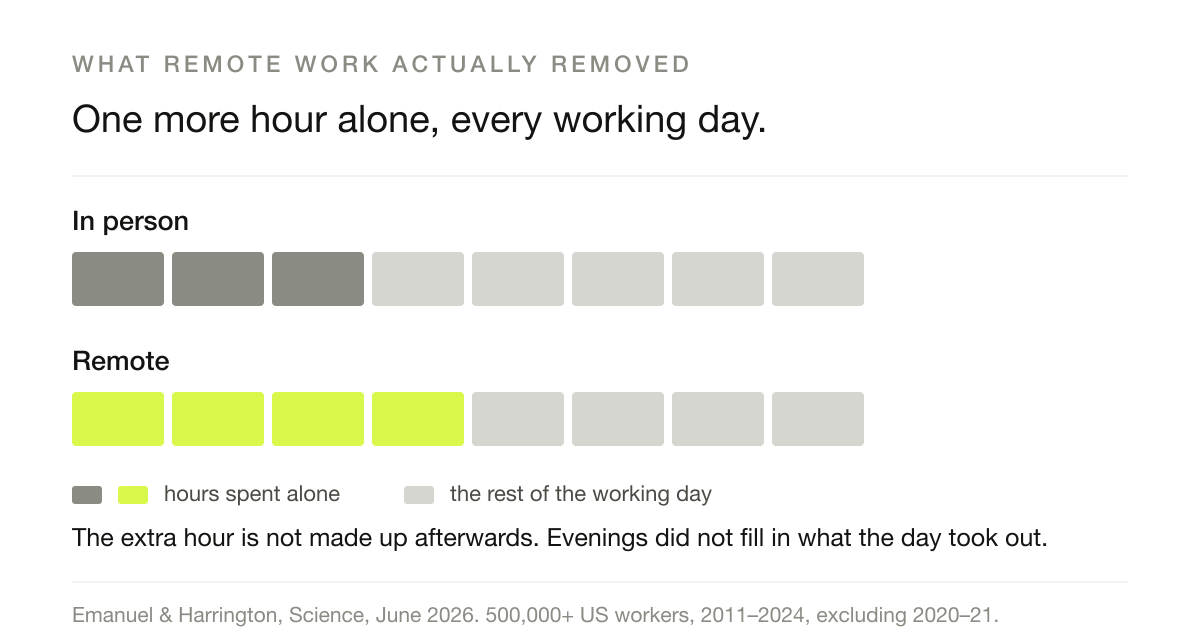
The concentration is the part worth knowing. For people who worked remotely and lived alone, the increase in isolation was roughly ten times that of remote workers sharing a home. The authors estimate remote work accounts for something like a third of the rise in mental distress across the period they studied.
So this is less about remote work as such and more about how much total contact a day contains. Remote work removed the reliable source. If your home is full of people, it likely refilled itself.
Why the usual advice does not land
Search this and you will be told to join a coworking space, schedule virtual coffees, or start a book group.
None of that is wrong. Coworking genuinely helps a lot of people, and the industry's own figures on it are strong, while being, reasonably enough, figures published by companies that sell desks, describing people who had already decided to go.
The problem is the size of the ask. Every one of those suggestions requires you to arrange contact, in advance, with a specific person or a paid membership, using energy you do not currently have. Loneliness is not a state that makes organising a book group feel achievable. That is close to a definition of the problem.
Advice that requires the resource you are short of is not advice. It is a description of the destination.
The smaller thing that works
Stop trying to fix the friendships. Give the day an edge.
One action, most days, that happens outside your home and within sight of other people. That is the whole instruction, and it is deliberately not social.
- Buy the coffee instead of making it.
- Walk a route that has a shop on it, and go into the shop.
- Do the last hour of work somewhere that is not your flat.
- Take the longer way to the thing you were going to anyway.
Notice what none of these require. No arrangement, no other person's calendar, no membership, no conversation you have to sustain. The bar is presence, not interaction. And presence turns out to be most of what the office was actually supplying.
The point is that the day stops being one continuous room from waking to sleeping. It gains a before and an after. That is a smaller repair than "build a community", and it is the one that is available on a Tuesday when you have nothing spare.
This is the same arithmetic as everything else here: a plan sized to the energy that exists beats a better plan sized to energy you do not have. We ran that argument properly in another post.
When it is more than this
Worth saying plainly, and then leaving alone.
This piece is about ordinary loneliness, the flat, quiet kind that comes from a day with no edges in it, and lifts when the edges come back. If what you are carrying is heavier than that, if it has been there for months regardless of how the day is arranged, or if it comes with things that are not really loneliness, then a professional is the right call and this is not a substitute for one. Cognitive behavioural therapy has good evidence behind it for exactly this.
No app should be pretending otherwise, including this one.
What Flowdayz does with it
Flowdayz is a feel good app: you learn what actually makes you feel good, usually the smallest things, and it helps you get there every day. This is exactly the kind of thing it is for.
When you build a flow, one of the anchors can be the walk, or the coffee bought rather than made, placed where your day actually has room rather than where a plan wishes it did. It is one action, on the screen, at the point in the day you said you would be free. Then the app is finished with you.
On a day you cannot, you press Not today, and nothing happens. Nothing resets, nothing turns red, and the days you did keep are still there in full. That matters more here than almost anywhere else, because a system that scolds you for a bad week is a poor companion for the specific problem of a week that already felt long.
Build your first flow. It takes about two minutes, and you can see the plan before you decide anything.
Questions people actually ask
- Why is working from home so lonely?
- Because an office supplied a large amount of contact that never felt like socialising. The walk in, the queue, the person at the next desk saying something about their weekend. It was low grade, constant and entirely incidental, and it did more work than anyone noticed. Losing it does not feel like losing friends, which is exactly why it is hard to name and easy to dismiss.
- How many days a week should I work from home?
- A study of 87,317 US adults in the Journal of Affective Disorders found no association between loneliness and one to two remote days a week. Three to four days showed the highest odds of more loneliness, and five or more days came in slightly lower. So it is not a straight dose. The half-in-half-out week fared worst, and the fully remote one slightly better. Both effects are modest. The practical read is that the number of days is a poor lever, and what a day actually contains is a better one.
- How do I stop feeling lonely working from home?
- Start smaller than the advice usually suggests. Rather than building a social life, put one thing in the day that happens outside your home and near other people. Buying the coffee instead of making it, walking a route with a shop on it, working the last hour somewhere else. The aim is not conversation. It is to give the day an edge, so it is not one continuous room from waking to sleeping.
- Is remote work bad for your mental health?
- The picture is not uniform. Emanuel, Harrington and Pallais, publishing in Science in June 2026 from more than half a million American workers between 2011 and 2024, found remote workers spent about an extra hour alone each working day and did not make it up in the evening. The effect concentrated sharply among people who both worked remotely and lived alone, where the isolation increase was around ten times that of remote workers sharing a home. If your home is already full of people, this is probably not your problem.
- Does a coworking space actually help?
- For many people, yes, and the figures the coworking industry publishes about it are genuinely good. Two caveats worth holding. Those figures come from companies selling desks, and they describe people who already chose to go. A coworking membership is also a large first step when your energy is low, which is the state that made you search for this. If it appeals, take it. If it has been on your list unbooked for a month, that is information, and something smaller is the better move.
Keep reading
You will keep the one you enjoy
September is the other resolution season, and the list gets picked from the wrong column. Usefulness predicts what you start. Enjoyment predicts what you keep.
Read itA habit needs a week that repeats
Habit advice assumes a week that repeats. If yours is an irregular schedule it fails you for a reason that is not discipline, and the research says why.
Read it
- loneliness
- remote work
- routines
- habits
- connection
Make every day your best day.
Flowdayz is a feel good app. You learn what actually makes you feel good, usually the smallest things, and get there every day, around the life you already have.