24 August 2026 · 7 min read · Updated 2 September 2026
The autumn slump has a timetable
The routine that worked all summer was cued by daylight. Daylight leaves faster in autumn than at any other time of year, and it takes the cue with it.
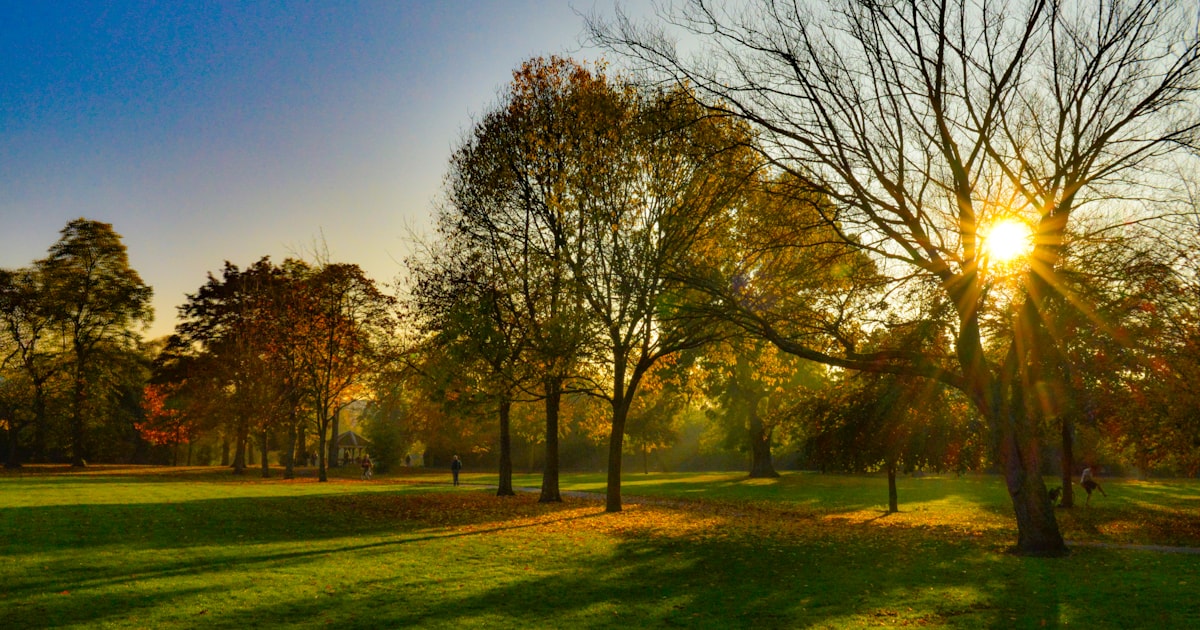
It is a Tuesday in the middle of October, about half six. The bag is by the door and the run has not happened.
Not refused, exactly. It just did not come up. You got in, it was already dark outside the kitchen window, and the idea of going back out arrived and left again in under a second, the way ideas do when they have to argue for themselves.
In July this run took no arguing at all. You did it perhaps four evenings a week without ever deciding to. Same shoes, same route, same person.
So the obvious reading is that something in you has gone soft since the summer. That reading is wrong, and it is wrong on a point you can check against a published table.
The light is on a schedule, and the schedule is public
In London, sunrise on 1 September falls at about 06.14 and sunset at about 19.45. By 30 September, sunrise is around 07.00 and sunset around 18.39. That is 46 minutes off the front of the day and 66 off the back, close to two hours of daylight gone inside a single month.
The rate is not constant through the year. Daylight changes most quickly around the equinoxes and most slowly around the solstices, which is why June feels like it lasts forever and October feels like somebody is pulling a plug. Through September and October at British latitudes the day shortens by roughly four minutes every twenty four hours. Further south the slope is gentler. New York loses closer to two and a half minutes a day over the same stretch, which is still an hour and a quarter of daylight across September.
Then, on one specific night, an hour moves. In the UK the clocks go back on Sunday 25 October 2026, in the United States on Sunday 1 November. Whatever you were doing outdoors after work stops being an outdoor activity that weekend.
None of this is a mood. It is arithmetic, and it was in the diary before the year started.
Habits are triggered, not summoned
Here is the part that turns the arithmetic into a missed run.
A habit is not a stored quantity of motivation you spend down. It is a behaviour that has been welded to a cue, so that the cue arrives and the behaviour follows without a decision being taken. That is the whole advantage of a habit, and it is also its whole vulnerability.
Wendy Wood, Leona Tam and Melissa Guerrero Witt tested this directly by following students who transferred to a new university (Journal of Personality and Social Psychology, 2005). They tracked three ordinary habits: exercising, reading the newspaper, watching television. The habits survived the move only where the context that triggered them survived. Where the cue changed, the behaviour stopped running automatically and fell back under conscious intention, which is a far weaker way to get anything done.
That study is about changing university, not about changing season, and nobody in it was measuring daylight. What transfers is the principle rather than the setting: a habit is only as durable as the cue underneath it.
Your evening run was never anchored to your character. It was anchored to the light, and the light is on a timetable that nobody consulted you about.
If the cue was "after work, while it is still bright out", then the cue has an expiry date already printed in the calendar. It does not fail. It retreats, four minutes a night, until one Tuesday the thing simply is not prompted any more.
Four minutes is too small to notice and too large to survive
This is why autumn gets blamed on the person rather than the planet.
A New Year resolution fails visibly. There is a day it stopped, usually a specific one, and the failure is legible enough to feel bad about. An autumn routine does nothing of the sort. Nothing breaks on the fourteenth. Each evening is imperceptibly darker than the one before, always inside the margin where you could still have gone, and the running total only becomes obvious weeks later when you notice you have not been out since about the middle of September.
There is no moment to point at, so the mind supplies the only explanation available, which is that you have changed. It reaches, as ever, for the character flaw rather than for the sunrise table.
The same mistake shows up every September, when people try to restore a routine that summer had already ended. The reset fails for reasons that have nothing to do with resolve, and this is the slower version of it.
Anchor to something that does not move
Two adjustments, and neither is about trying harder in worse conditions.
Re-anchor the action to an event rather than a light level. Shutting the laptop. The kettle going on. Walking in through the front door before you sit down. The last meeting ending. These cues are identical in December and in June, which is the entire point of choosing them. "When it is still light out" is a cue that works for roughly eleven weeks of the British year and then withdraws its support without notice.
If the action genuinely needs daylight, move it rather than defend it. A run at half six in October is a different proposition from a run at half six in July, and pretending otherwise is how people end up with neither a run nor a good evening. Lunchtime is available and unfashionable. So is the twenty minutes before work, which will cost you nothing in October and something real by December. There is decent evidence for daylight itself as one of the very few morning steps that earns its place, so getting outside at some point is worth protecting even if the specific activity changes.
And then the part that matters most in a season designed to interrupt you: count the days you keep rather than the ones the calendar takes. Autumn will take some. A record that only rises will survive a dark fortnight. A consecutive-day streak will not, and it will hand you a reason to stop entirely in the exact month you were most likely to.
That is the whole design position behind Flowdayz, a feel good app. One small thing that makes you feel good, sized to the day that actually exists, and a record that never punishes you for October.
What this is not
A routine that needs re-anchoring is a logistics problem, and it is worth being clear that not everything in this season is.
If the low mood is the thing itself, if it holds for weeks, changes how you sleep or eat, or takes the interest out of things you would normally want, that is not a scheduling error and no app is the right tool for it. That is a conversation with a doctor. Autumn is a reasonable time to have it.
The light will do this again next year
It will, and roughly to the minute, which is the useful part.
You do not need to feel differently about October. You need one action attached to something that does not get dark.
Questions people actually ask
- Why do I lose motivation in autumn?
- Often because a cue disappeared rather than because anything about you changed. Most summer routines are anchored to daylight, explicitly or not, and daylight retreats faster in September and October than at any other point in the year. The evening walk that happened by itself in July needs a decision in October, and a decision is far more expensive than a trigger. What feels like fading motivation is usually a habit that has stopped being prompted.
- Is the autumn slump real, or is it in my head?
- The scheduling part is measurable and public. In London, sunrise moves from about 06.14 on 1 September to about 07.00 on 30 September, and sunset from about 19.45 to about 18.39. That is close to two hours of daylight gone inside one month. Whether the mood dip that often comes with it is caused by the light, by the return of a busier calendar, or by both, is much less settled. The timetable is not in doubt.
- Why does my routine fall apart when the clocks go back?
- Because the clock change moves an hour of daylight from the evening to the morning overnight, and most people's discretionary time sits in the evening. In the UK the clocks go back on Sunday 25 October 2026, in the United States on Sunday 1 November. Anything you did after work in the light stops being possible in the light on a single specific date, which is why that week feels so abrupt compared with the slow drift before it.
- How do I keep a habit going through the darker months?
- Attach it to something that does not move. Shutting the laptop, the kettle boiling, walking through the front door, the end of the last meeting. Those cues are identical in December and June. Anchoring to "when it is still light out" works beautifully for about eleven weeks a year and then quietly stops, and switching the anchor is usually cheaper than switching the habit.
- When is it more than a seasonal dip?
- When it is the mood itself rather than the schedule. A routine that needs re-anchoring is an ordinary logistics problem. Low mood that persists for weeks, changes how you sleep or eat, or takes the interest out of things you normally like, is a different thing, and it is worth taking to a doctor rather than a habit tracker. Nothing in this post is a substitute for that conversation.
Keep reading
You will keep the one you enjoy
September is the other resolution season, and the list gets picked from the wrong column. Usefulness predicts what you start. Enjoyment predicts what you keep.
Read itMost of the morning routine is decoration.
The twelve-step morning routine is mostly unproven. Two parts of it, daylight and water, have real research behind them. What that leaves you to actually do.
Read it
- seasons
- routines
- habits
- daylight
- motivation
Make every day your best day.
Flowdayz is a feel good app. You learn what actually makes you feel good, usually the smallest things, and get there every day, around the life you already have.