25 August 2026 · 6 min read
Habit stacking asks a habit to do a clock's job
Habit stacking works until the habit underneath it does not happen. The problem is rarely your discipline. It is that an anchor can itself fail to turn up.

You wrote the stack on a Sunday, and it was a good one.
After the coffee, the vitamins. After the vitamins, ten minutes of reading. After the reading, the three lines in the notebook. It read like a morning that a competent person has, because it was, and because every single item in it takes under ten minutes.
It ran beautifully for four days.
Then Thursday happened. You had an early call, so you took the coffee to the desk instead of standing in the kitchen with it. The vitamins are in the kitchen. And that was the whole morning gone, all three items, without a single decision being made about any of them.
The advice you will get is to fix the anchor
Search this problem and you will be told, kindly and repeatedly, that your anchor was unreliable, or your new habit was too big, or the energy levels did not match, or you tried to stack too much at once. Tune the stack. Try again.
Some of that is true. None of it is the mechanism, and the tuning advice quietly assumes the design is sound and you implemented it badly.
The design has a specific, identifiable weak point, and it was introduced deliberately.
Habit stacking changed one word in something that worked
The idea underneath habit stacking is not new and is not soft. It is the implementation intention, an if-then plan of the form "if situation Y is encountered, then I will do X". Peter Gollwitzer and Paschal Sheeran pooled 94 independent tests of those plans in Advances in Experimental Social Psychology in 2006 and found a medium to large effect on whether people actually did the thing, d = 0.65. That is a real result, and it is the reason this whole genre of advice exists.
James Clear, who named habit stacking in Atomic Habits, is completely open about the lineage. He calls it a special form of an implementation intention, and describes the difference plainly: instead of pairing the new habit with a particular time and location, you pair it with a habit you already have.
The reasoning for the swap is intuitive. The existing habit is already wired in, so it makes a stronger, more specific cue than a clock does.
But a time and a place have a property that a habit does not have. They turn up anyway.
A situation happens whether or not you cooperate. A habit is something you have to do.
Eight in the morning arrives on days you are ill, travelling, hungover or busy. Your desk is still your desk. The front door still opens. None of those things has a hit rate, because none of them is a behaviour.
Your morning coffee is a behaviour. It has a hit rate. And the moment you stack on top of it, that hit rate becomes yours.
The arithmetic nobody writes down
Say the coffee ritual, the actual standing-in-the-kitchen version, happens five days in seven. That is a good habit by any reasonable standard. And say that when it does happen, you follow it with the new thing four times out of five, which is also good.
Four days a week. Not five, and not seven.
Now add the third link, the notebook after the reading, at the same generous four-in-five.
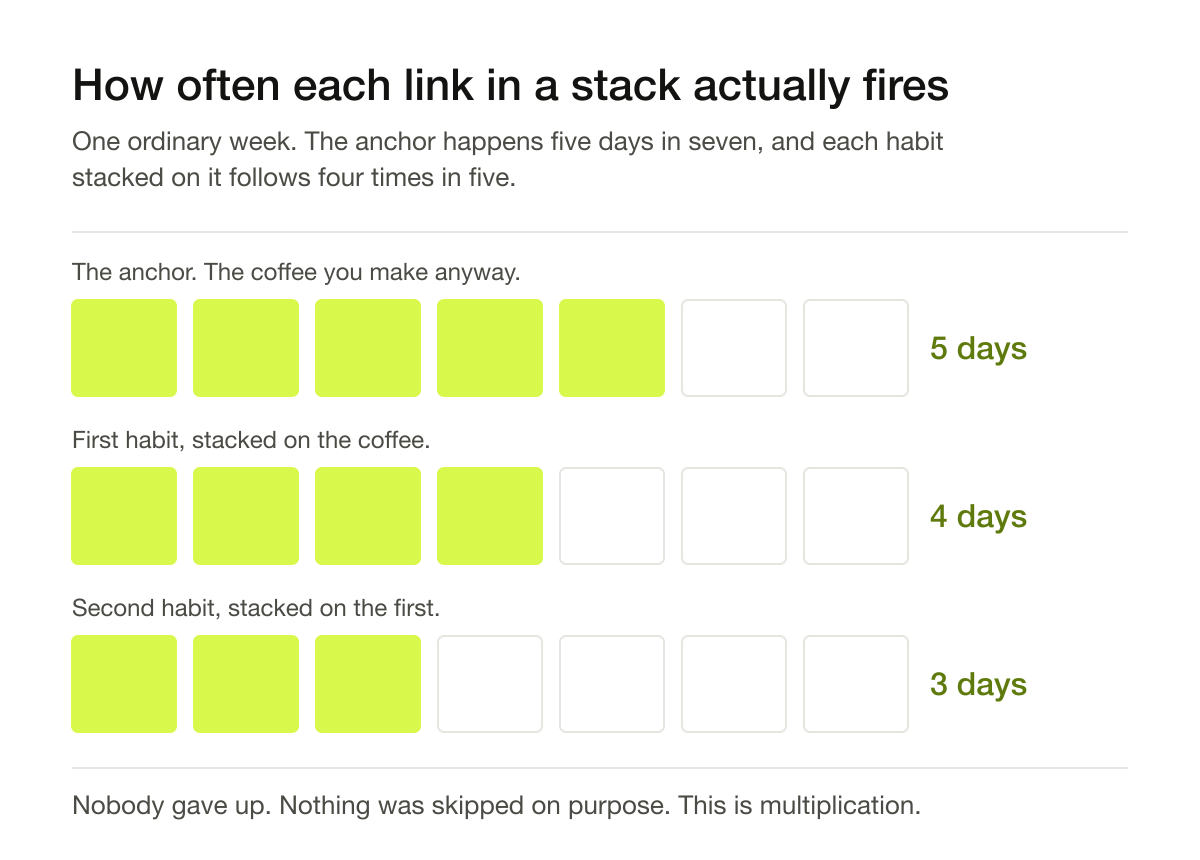
Three days. From a chain in which every single component is performing well.
This is the part that makes it feel like a character problem. You did not decide to skip anything. You have no memory of quitting. The links fail from the front, silently, so a missing coffee takes the reading and the notebook with it, and what you notice at the end of the month is only that the whole thing has stopped and you cannot say when.
Clear does warn about anchor frequency, and he is right to: he says the cue should happen as often as you want the habit to happen. But frequency and reliability are different questions. A daily habit is not a habit that happens every day. It is a habit that happens most days, and "most" is a number below one, and numbers below one multiply downwards.
What to do with it instead
Three constraints, and they are all subtractions.
Anchor to a situation, not to a behaviour. Arriving at the desk rather than finishing the coffee. Shutting the laptop rather than completing the last task. The kettle boiling is weaker than the kitchen, because the kettle needs you and the kitchen does not. This is the same repair that works when a summer routine falls apart in October: find the cue that does not have an expiry date on it.
Keep one link. Not because two is greedy, but because the second one costs you a day a week and does not announce it. If you want two new things, give them two separate situations rather than one chain, and they will fail independently instead of together.
Check the anchor before you trust it. For one week, do not add anything. Just notice how many days the anchor actually happens. Most people find their unshakeable morning ritual is a five-day habit with a weekend in it, which is fine, as long as you know that before you build on it.
None of this is an argument for doing less. It is an argument for putting the thing you care about on ground that holds. There is a reason starting three habits at once tends to cost more than three times as much, and the same shape shows up here in a different disguise.
The version we build into Flowdayz is one small thing a day that makes you feel good, attached to an hour that is genuinely still yours. One link, and it is anchored to the day rather than to your own compliance. If you want that decided for you rather than negotiated every morning, that is what /start is for.
Your stack did not fail because you lack discipline. It failed because you put a habit where a clock should have been, and clocks are the more dependable of the two.
Questions people actually ask
- Why does habit stacking not work for me?
- Usually because the habit you stacked onto is less reliable than it feels. A stack only runs when every link before it ran, so the links multiply rather than add. An anchor that happens five days in seven, followed four times in five, gives you four days. Add another link and you are at three. That is arithmetic, and it happens on weeks when you refused nothing and forgot nothing.
- What makes a good anchor for a new habit?
- Something the day performs whether or not you cooperate. An arrival, a time, a place, walking through the front door, the end of the last meeting. The research behind implementation intentions is built on situational cues of exactly that kind, and a situation has no compliance rate. One of your own habits does have one, and you inherit it in full the moment you stack on top of it.
- Is habit stacking backed by science?
- Partly, and the part matters. It is built on implementation intentions, if-then plans that spell out when, where and how you will act. Gollwitzer and Sheeran pooled 94 independent tests of those in Advances in Experimental Social Psychology in 2006 and found a medium to large effect, d = 0.65. What that work tested was situational cues. Swapping an existing habit in for the situation is a popular extension of the idea rather than a finding inside it.
- How many habits can I stack together?
- One link, until the anchor is genuinely close to certain. Every extra link multiplies the odds down, so a chain of three built on an anchor that fires most days will run perhaps three times a week, which is rarely what the person writing the chain had in mind. Brushing your teeth can carry a link. The coffee you sometimes buy on the way in cannot.
- Does missing one day ruin a habit?
- There is direct evidence that it does not. Lally and colleagues followed 96 people building a daily habit over twelve weeks and reported that missing one opportunity to perform the behaviour did not materially affect the habit formation process (European Journal of Social Psychology, 2010). The same study found the time to reach near-automatic ranged from 18 to 254 days across individuals. The useful question is whether the cue keeps turning up, not whether the record is unbroken.
Keep reading
A habit needs a week that repeats
Habit advice assumes a week that repeats. If yours is an irregular schedule it fails you for a reason that is not discipline, and the research says why.
Read itYou will keep the one you enjoy
September is the other resolution season, and the list gets picked from the wrong column. Usefulness predicts what you start. Enjoyment predicts what you keep.
Read it
- habits
- routines
- planning
- cues
Make every day your best day.
Flowdayz is a feel good app. You learn what actually makes you feel good, usually the smallest things, and get there every day, around the life you already have.