BlogThe shape of the day
How to structure your day when you start working from home
The office gave your day a shape you never had to plan. At home, plan the shape before the tasks: when you start, when you stop, the break, and the one thing.
 Watch the film · 4 minHow to structure your day when you start working from home
It is your third week in the new job. Or the third week working for yourself, which is the same week with fewer meetings.
The first days felt like freedom. No train, no alarm at six, coffee in the good mug. Now the laptop opens in bed at twenty to eight because a message came in. Lunch happens over the keyboard, if it happens. At nine in the evening you answer one more thing, and at ten you cannot say what the day was.
Nobody gave you a manual for this. The job came with a laptop, a login and a welcome call. Not with a day.
The usual advice says the answer is discipline, or a better app, or a calendar blocked out hour by hour. None of that is the problem. You did not lose your discipline when you left the office. You lost the structure the office was quietly supplying.
The office gave your day a shape you never had to plan
Think about what an office day did for you without asking.
The commute started the day and ended it. Lunch happened because people stood up and went. Meetings were in rooms, so walking to the next one was a small break. The building closed, the lights went off, and the day had a last page.
None of that was designed as structure. All of it was structure.
At home every one of those edges is gone, and the day stretches to fill the space. When offices emptied in 2020, a study of meeting and email data from more than three million people found the span from the first email or meeting to the last grew by about 48 minutes (DeFilippis and colleagues, Humanities and Social Sciences Communications, 2022). It measured the span of the day rather than hours worked. But spread out is exactly the problem: a day with no edges is long even when it is not full. We wrote about why that leaves you so tired even when you barely moved.
Why the first months are the best time to set it
Here is the good news for anyone who has just started.
Habits are tied to places and times. When the place and the time change all at once, old habits lose their grip for a while, and new ones are unusually easy to build. Researchers call this the habit discontinuity hypothesis.
Verplanken and Roy tested it in a field experiment with 800 households, published in the Journal of Environmental Psychology in 2016. An intervention to change everyday habits worked better for people who had recently moved house, and the window lasted roughly three months after the move. The habits in that study were sustainable everyday behaviours such as energy use and travel, not workdays, and the effect was modest, so treat it as a strong hint rather than a law. But starting to work from home is as big a change to your daily setting as moving house, and the logic is the same.
The first months are a window. Whatever shape your day takes in them tends to become the shape it keeps.
It also takes longer than people think. In a study of new daily habits, Phillippa Lally and colleagues found a median of about 66 days before a behaviour became automatic, with a very wide range between people (European Journal of Social Psychology, 2010). The famous 21 days is a myth. So expect the first weeks to feel like effort, and give a new routine around two months before you judge it.
Your first six months working from home, week by week
- The window: old habits are loose, roughly the first three months
- After it, the shape you kept is harder to change
Plan the shape before the tasks
Most advice on structuring a day at home is really advice on planning tasks. Write a list, rank it, block it into the calendar hour by hour.
The trouble is that task plans are the part of the day you are worst at predicting. Roger Buehler, Dale Griffin and Michael Ross asked psychology students when they would finish their senior thesis, in the Journal of Personality and Social Psychology in 1994. On average the students expected to need about 34 days and took 55.5, and only about three in ten finished by the day they had predicted. The study was about students and big projects, not a Tuesday, but the pattern, known as the planning fallacy, has been found again and again: people plan for the best case.
Students who said when their thesis would be done
Students, not workdays3 in 10
finished by the day they predicted. On average it took longer than they predicted.
So an hour by hour plan for a workday overruns by lunch, and then the whole structure feels broken. We wrote about why the to do list keeps losing for the same reason: a list records what you hope to do, not how much room the day has.
The edges are different. You cannot predict how long the proposal will take. You can decide when you start, when you stop and when you eat. Those are the part of the plan you can actually keep, and they are what the office used to give you.
There is good evidence that this kind of planning works. Peter Gollwitzer and Paschal Sheeran pooled 94 tests of plans in the form “when this happens, I do that” in Advances in Experimental Social Psychology in 2006, and found they helped people follow through on their goals with a medium to large effect. Nobody has tested planning the edges of a remote workday as such, but “at 12:30 pm I close the laptop and eat in the kitchen” is exactly that kind of plan.
Plan the shape of the day, not the tasks. The tasks change every day. The shape is what you can keep.
And it is worth doing for more than output. Brad Aeon, Aïda Faber and Alexandra Panaccio pooled 158 studies of time management covering 53,957 people, in PLOS ONE in 2021. Time management was moderately linked to job performance, but slightly more to wellbeing, and it went with less distress. Most of those studies were snapshots, so it is a link rather than proof. But it fits what people who work from home actually want from a structure: not more done per hour, a day that feels finished.
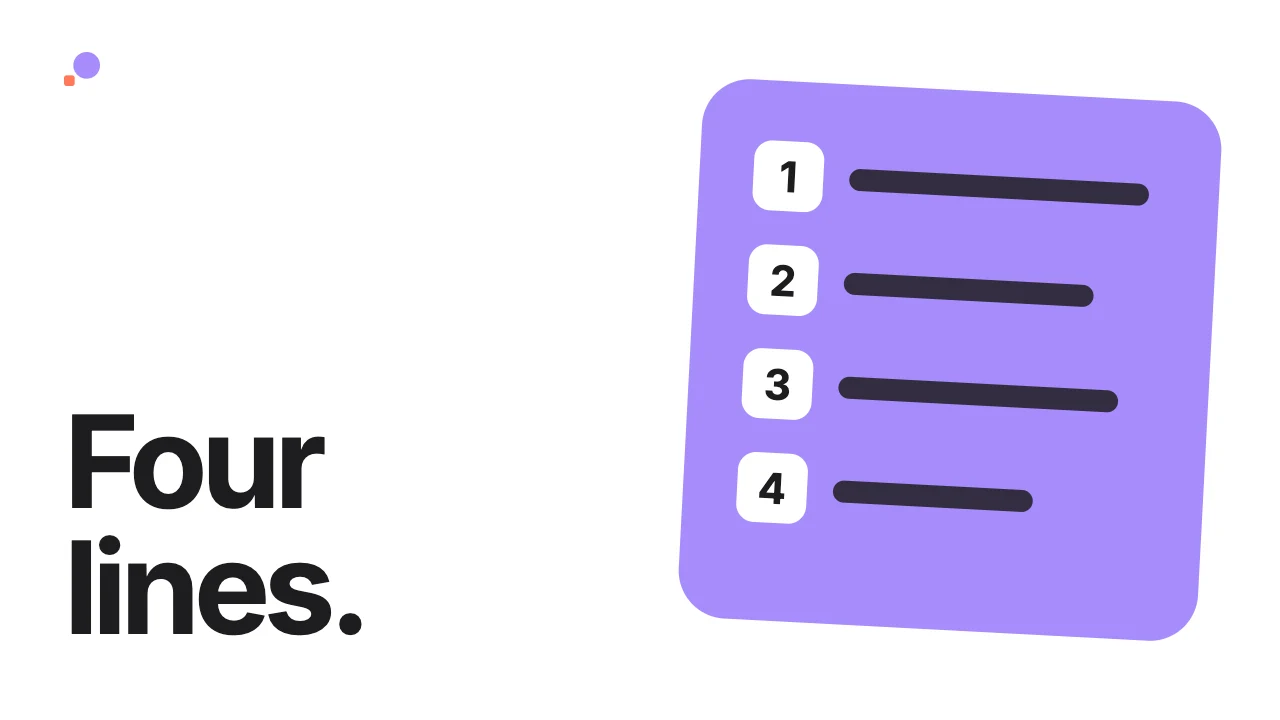
The four lines
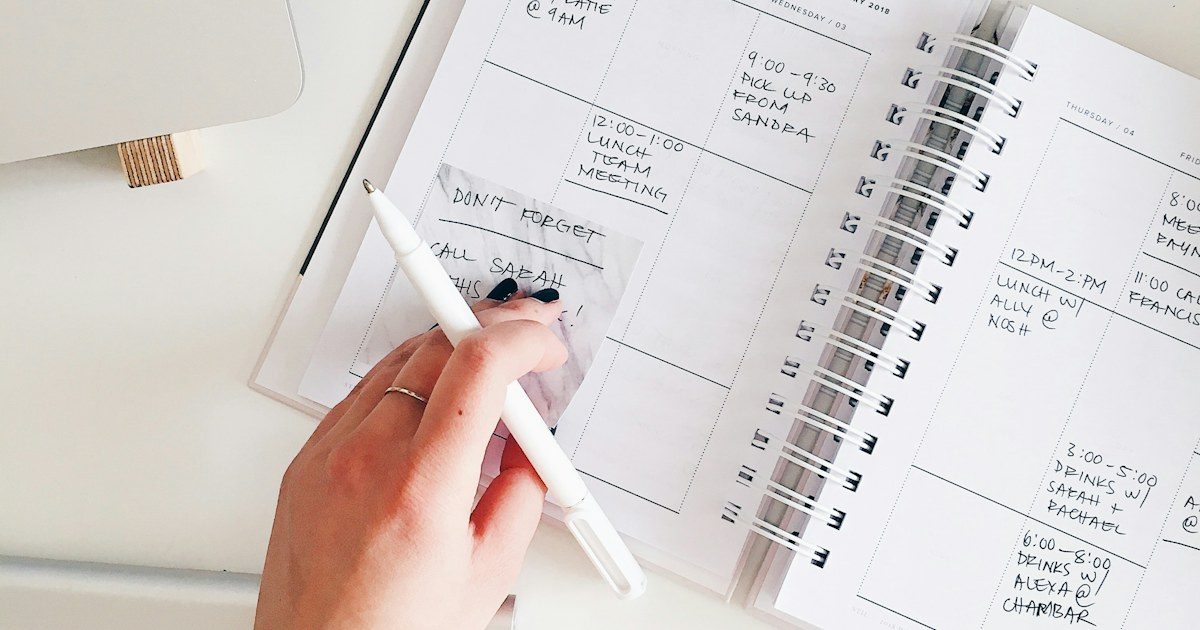
Before you open a single message, write four lines. On paper, in a notes app, on a sticky note on the laptop. It takes under a minute.
Today
- Start9 am, the one thing first
- One thingSend the onboarding plan
- Break12:30 pm, lunch in the kitchen
- Stop5:30 pm, then the shutdown
Before the first message Under a minute, on paper or in a note.
- When you start. A time, and what you do first. Ideally the first half hour goes to the one thing, before messages decide the morning for you.
- The one thing. The single piece of work that would make today count if nothing else got done. One, not five.
- Where the break goes. A real one, away from the screen. A lunch break people chose and spent relaxing went with the least fatigue at the end of the day in an experience sampling study by John Trougakos and colleagues (Academy of Management Journal, 2014).
- When you stop. A time, treated as the end whatever is still open, followed by a short shutdown. That part has its own post: how to switch off from work when you work from home.
Everything else, the meetings, the messages, the list, fits into the space between those lines. That is the whole structure.
What a day like that looks like
Here is one example of a work from home daily schedule built on the four lines. Change every time to fit your job; keep the shape.
One example day, built on the four lines
- 9 amThe one thing, before messages
- 10:30 amMessages, meetings, the list
- 12:30 pmLunch away from the screen
- 1:15 pmMeetings, messages, the list
- 3:30 pmA walk round the block
- 3:45 pmThe list
- 5:25 pmFive minute shutdown
- 5:30 pmStop
If you are an employee, the meetings will move around inside it and that is fine. The edges stay. If you freelance, there is no manager to start or end your day and clients will happily fill every hour you leave open, so the stop time matters even more, and so does putting client messages into set times rather than answering all day.
Three rules for the first weeks
Not a programme. Three constraints, in the order they matter.
- Write the four lines before the first message. Once you have read your messages, the day already belongs to someone else.
- Keep the shape the same most days. Same start, same break, same stop. The point of the window is to repeat something until it sets.
- Judge it after two months, not two days. Week one will feel forced. Adjust one line at a time, never the whole plan.
Plans also go wrong on a schedule of their own. A Sunday plan meets a Wednesday that was never that empty, which is why weekly plans tend to fail from optimism rather than laziness. Daily edges are smaller, and they survive Wednesday.
The one thing to try tomorrow
Before you open a single message, write four lines: when you start, when you stop, where the break goes, and the one thing that matters today.
Then open the messages.
If you want to know whether the shape of the day is the lever that matters most for you, or whether it is the first hour, the breaks or the evening, take the two minute workday check. It names your two biggest levers.
Nobody gave you the manual. The first page is four lines long.
Questions people ask
How do I structure my day when working from home?
Start with the shape, not the tasks. Decide four things before you open any messages, when you start, when you stop, where your break goes, and the one piece of work that matters today. Put the one thing in the first hours, before messages take over. Fit everything else into the space between. A task list on its own does not give a day structure, because lists grow and overrun; the edges are what hold.
What is a good work from home daily schedule?
One you can keep on an ordinary day. A simple example is start at 9 am with the one thing before messages, check messages at set times, take a lunch away from the screen at 12:30 pm, a short walk mid afternoon, and stop at 5:30 pm with a five minute shutdown. The exact hours matter less than keeping the start, the break and the stop the same most days.
How long does it take to get used to working from home?
Usually longer than people expect. In one study of new daily habits, it took a median of about 66 days for a behaviour to become automatic, with a very wide range between people (Lally and colleagues, European Journal of Social Psychology, 2010). So give a new routine about two months before you judge it, and expect the first weeks to feel like effort.
What should I do in my first week of a remote job?
Set the shape of the day before habits set themselves. Pick a start time and a stop time and keep them, plan one real break, and write the next day's one thing before you finish. The first weeks of a big change are when old habits are weakest, which makes them the easiest time to build new ones.
How do I structure my day as a freelancer working from home?
The same way, with one difference. Nobody else starts or ends your day, so the stop time has to be yours and written down. Plan the four lines each morning, put client messages into set times rather than all day, and protect the one thing that moves your own work forward, because client requests will fill every gap you leave.
Is time blocking worth it when working from home?
Blocking the shape of the day helps; blocking every hour usually does not survive the afternoon. People reliably underestimate how long tasks take, which is why an hour by hour plan falls apart. Block the start, the one thing, the break and the stop, and leave the rest of the day open for the work as it actually comes.
One small thing a week.
A short email with one idea for your workday at home, and how sure the science is. No noise. Leave any time.